Advantages and Disadvantages of Agrivoltaic Systems
Whether a feature of agrivoltaics counts as a gain or a cost depends on what the land would otherwise be doing. A farmer and a solar developer can study the same field and reach opposite conclusions, and both can be right. In 2018, the elevated array of a long-running field trial at Heggelbach in southern Germany generated about 83% of the electricity a conventional plant would have produced on the same area. The potatoes growing under the modules still out-yielded an open-field reference plot that year. A year earlier, they had fallen short.
- Agrivoltaic systems keep farmland in production while generating electricity, but they cost more to build and produce less power per hectare than a conventional ground-mount PV plant.
- A field that grows crops and generates solar power can out-produce the same land split between the two uses, most clearly where shade eases heat and drought stress.
- Agrivoltaic capital costs typically run 20–90% above conventional ground-mount PV, with most of the premium going into the mounting structure, its foundations and installation.
- Most berries and other fruiting crops hold or raise their yield under light shade. Maize and grain legumes lose yield even under modest shading.
- Agrivoltaics fits best on hot, dry or hail-prone sites with crops that tolerate or benefit from shade. Many rules also require crop yields to reach a set share of a reference yield.
Table of Contents
- Agrivoltaics vs Farming Alone and Conventional Solar
- Advantages of Agrivoltaic Systems
- Disadvantages of Agrivoltaic Systems
- Which Crops and Livestock Suit Agrivoltaics?
- Why Agrivoltaic Systems Cost More
- When Does Agrivoltaics Make Sense?
- Planning an Agrivoltaic Structure with Mibet
- Agrivoltaic System FAQs
Agrivoltaics vs Farming Alone and Conventional Solar
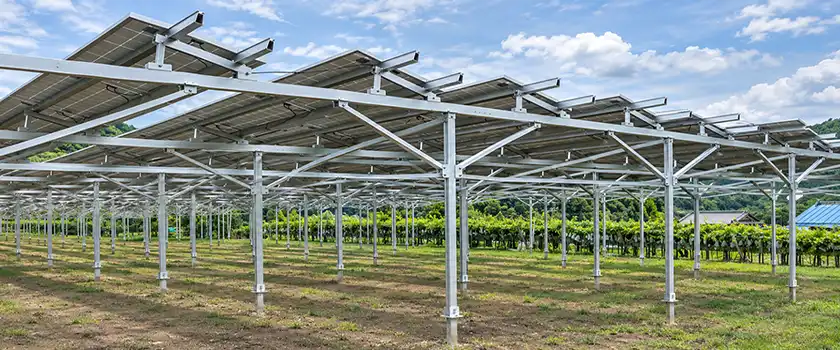
In an agrivoltaic system, farming remains the primary use of the land, and power generation is a secondary use. Germany's DIN SPEC 91434 pre-standard and France's 2024 agrivoltaics decree both define the practice this way. It goes by Agri-PV in much of Europe and solar sharing in Japan, and in the United States it is grouped under the broader label dual-use solar.
Agrivoltaics combines two land uses, so every advantage and disadvantage has two reference points. Compared with farming alone, the array is an addition. Measured against a conventional ground-mount PV plant, the farming requirements become a constraint.
| Attribute | Farming alone | Agrivoltaic system | Conventional ground-mount PV |
|---|---|---|---|
| Agricultural output | Full | Held, reduced or raised, depending on crop and climate | None, or grazing only |
| Electricity per hectare | None | Lower, because modules cover less of the ground | Highest |
| Capital cost per kW | Not applicable | Higher, mainly in structure and installation | Lowest |
| Field operations | Unrestricted | Work around columns, under or between module rows | Vegetation management only |
| Land status and permitting | Agricultural | Often permitted on farmland under agrivoltaic rules, with yield conditions | Often restricted on productive farmland |
A farm owner adding solar weighs the effect on crop output and field work against a new revenue stream. A developer looking at farmland weighs the higher cost and lower electricity output against access to land where a conventional plant may not be permitted. A separate guide compares the elevated, vertical and inter-row structures behind these trade-offs.
Advantages of Agrivoltaic Systems
Agrivoltaic systems offer four main advantages: more combined output per hectare, a cooler and moister growing environment for many crops, a second source of farm income, and access to farmland closed to conventional plants.
More Total Output from the Same Land
Researchers measure dual land use with the land equivalent ratio (LER). It adds two relative yields: the crop yield under the array as a share of an open-field reference yield, and the electricity output as a share of what a conventional plant produces on an equal area. An LER above 1.0 means the combined system produces more than the land would if it were divided between the two uses.
An LER of 1.6, for example, can come from a crop at 80% of its reference yield and electricity at 80% of a conventional plant's output. Growing that harvest and generating that electricity on separate plots would take 1.6 hectares instead of one.
At Heggelbach, land productivity rose by 56–70% in 2017, depending on the crop. In the hot, dry summer of 2018, land productivity on the potato plot rose by 86%. That year, shade eased heat and drought stress on the crops, and the sunny season lifted electricity output. Does a higher LER mean a better investment? No. It measures land use, not returns.
Shade, Shelter and Water Savings for Crops
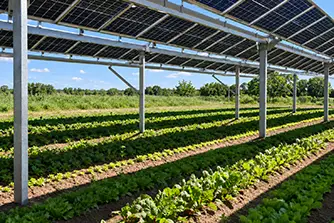
Many crops reach a light saturation point. Above that point, extra sunlight adds little to photosynthesis but still raises leaf temperature and water loss. Partial shade from the modules lowers that heat load and slows evaporation from the soil.
The effect is strongest in drylands. In a University of Arizona study, soil under the array held about 15% more moisture than open ground when both were watered every other day. Cherry tomato plants in the shade produced twice as many fruits as those in full sun. The crops also cooled the modules above them as they transpired. From the measured temperature drop, the researchers estimated about 1% more electricity a year.
Elevated arrays give orchards, vineyards and berry crops partial shelter from hail and sunburn.
A Second Income Stream for the Farm
Electricity revenue does not depend on the harvest. Power sales, lease payments from an energy operator and savings on the farm's own power bill all continue through a poor crop year. Each kilowatt-hour you use on the farm is often worth more than one you export, because it replaces electricity bought at retail rates for irrigation pumps, cold storage or processing.
Access to Farmland and Agrivoltaic Incentives
In many regions, conventional ground-mount PV on productive farmland faces planning restrictions, and agrivoltaic rules open a separate route:
- In Germany, agrivoltaic systems can currently bid in solar tenders under the Renewable Energy Sources Act (EEG), with a bonus for elevated designs that leave at least 2.1 m of clearance.
- In the United States, the Massachusetts SMART program offers an incentive adder for qualifying dual-use agricultural solar.
Keeping the field in farming can smooth conversations with neighbors and local authorities, though it will not remove local opposition on its own.
Disadvantages of Agrivoltaic Systems
The main disadvantages of agrivoltaic systems are:
- a higher capital cost
- less electricity from each hectare
- the daily work of farming around a permanent structure
- the obligation to prove that farming continues
- yield losses for sun-demanding crops
Higher Capital Cost per Kilowatt
A 2025 international review found that agrivoltaic systems are typically 20–90% more expensive to install than conventional PV. Vertical and inter-row layouts use frames close to standard ground-mount designs and stay near the low end of that range. Elevated structures, tall enough for machinery to work underneath, sit at the top or beyond.
Less Electricity per Hectare
To leave light for the crop, agrivoltaic layouts use a lower ground coverage ratio (GCR) than a conventional plant, putting less of the ground under modules and fewer kilowatts on each hectare.
With fewer kilowatts installed, energy per hectare falls even when specific yield (annual output per kilowatt) holds steady or rises slightly through module cooling. Costs that scale with land area, such as cabling and fencing, are then spread over fewer megawatt-hours.
Farming Around a Permanent Structure
Columns and module rows become permanent obstacles. Machinery routes, headland turns and spraying passes have to fit around them for decades. Over that time, farm equipment and crop plans may change more than once.
Cleaning or replacing modules on an elevated frame usually requires lifts and access lanes kept clear of the crop. Dust from tillage and harvest settles on the module glass, and cleaning may be needed more often than on a grassed solar site.
On fixed-tilt arrays, rain runs off the low edge of each module row and lands repeatedly on the same narrow strips. Field observations from Heggelbach show a silted soil surface in the potato rows under those runoff lines and uneven rainfall across the rest of the field. Gaps between modules, or single-axis trackers that shift the drip line through the day, can spread the water more evenly.
Yield Targets and Reporting Obligations
Agrivoltaic status is conditional, and many frameworks tie it to measured farm output.
- France: Under Decree No. 2024-318, crop yields must exceed 90% of the yield on a nearby control plot without panels, or of an equivalent reference.
- Japan: Yields under the panels must stay above 80% of the local average, with the permit holder reporting harvest results every year.
- Germany: The DIN SPEC 91434 pre-standard sets a minimum agricultural yield of 66% of a reference yield.
These thresholds turn crop choice into a compliance decision. A shade-sensitive crop planted under a dense array can fall below the threshold in a cloudy, wet season, and the next report puts the permit or incentive at risk. Because spacing and coverage are set once the foundations go in, the layout has to suit the least shade-tolerant crop in the rotation, with a margin for poor seasons.
Which Crops and Livestock Suit Agrivoltaics?
Under light shade, most berries, tree fruit and fruiting vegetables hold or raise their yield. Forage, leafy vegetables, root crops and small grains lose a modest share of yield, and maize and grain legumes take the largest losses. Among livestock, sheep are the usual match. These groups come from a 2022 meta-analysis led by University of Hohenheim researchers.
Light saturation explains most of this pattern. For berries, forage and other tolerant crops, light shade mostly removes sunlight they could not use anyway. Maize keeps turning extra light into growth even in full sun. Even a little shade costs it yield.
| Crop group | Typical response to shade | Examples | Conditions |
|---|---|---|---|
| Shade-benefiting | Yield held or raised under light shade | Blueberries, tree fruit, tomatoes, peppers | Not all berries respond equally; gains are largest under high heat and light |
| Shade-tolerant | Yield loss smaller than the share of light removed | Strawberries, forage grasses, clover, lettuce, potatoes, wheat, barley | Losses grow as shade deepens |
| Shade-sensitive | Sharp yield loss even under light shade | Maize, soybean, field beans | Usually a poor match for dense arrays |
Most trials behind these groups used shade nets or intercropping, with few agrivoltaic field sites. Shade nets cut light more evenly than modules, which cast moving bands of shade and concentrate rain along their drip lines. The groups give your crop plan a starting point, and site trials or crop models narrow down the expected yield.
Over two spring seasons, an Oregon State University grazing study on a working solar farm found that pasture within the array yielded 38% less forage than open pasture. Lambs on both pastures gained weight at similar rates, because the shaded forage was higher in quality. The main layout requirements for sheep are keeping the modules' lower edge above the animals' reach and protecting cables from chewing.
Why Agrivoltaic Systems Cost More
Most of the extra cost sits in the mounting structure, its foundations and the work of building it. The premium has four main sources:
- Taller columns and longer spans. Machinery clearance means taller columns, and open working lanes mean longer beams. Material per kilowatt rises with both.
- Larger foundations. Wind acting higher up has a longer lever arm, raising the overturning moment at each column base. Driven piles and ground screws need deeper embedment or a larger section to resist it.
- Work at height. Elevated frames need lifts and take longer to erect.
- Wider spacing and deeper cabling. Lower ground coverage means more land and longer cable runs per megawatt. Cables in cultivated fields must run below the reach of plows and subsoilers. A 2021 agrivoltaics report from Bavaria's Technology and Support Centre (TFZ) calls for burial at least 1 m (3.3 ft) deep.
The same report shows how much the design changes the installed cost.
Estimated installed cost per kilowatt peak for the reference designs in the 2021 TFZ report, not current market prices.
When Does Agrivoltaics Make Sense?
Agrivoltaics makes the most sense when the crop benefits from shade or tolerates it, the climate is hot or dry enough for shade to protect yields, and policy rewards keeping the land in farming.
- Hot, dry or high-irradiance climates where heat and water stress limit yields
- Berries, tree fruit, fruiting vegetables, forage or sheep grazing
- Farmland where conventional plants are restricted, or where agrivoltaic incentives apply
- High daytime electricity use on the farm and grid capacity within reach
- Large maize or soybean rotations worked with wide machinery
- Cool, cloudy regions where light already limits the crop
- No agrivoltaic incentive, with cheaper non-farm land available for a conventional plant
- No committed farm operator for the life of the system
For your own site, weighing the advantages and disadvantages starts with four questions: who will farm the land, which crops and machines the layout must accommodate over its life, which agrivoltaic rules apply, and where the electricity will go. The answers set the target capacity, along with the clearance, row spacing and coverage the mounting structure has to deliver.
Planning an Agrivoltaic Structure with Mibet
Mibet manufactures agrivoltaic mounting systems in two forms: elevated structures that keep machinery lanes open beneath the modules, and raised fixed-tilt structures for inter-row cropping and sheep grazing. The elevated agrivoltaic structures provide ground clearance from 1.8 m (about 6 ft) upward, set to suit the farm's machinery and local rules. They accept framed or frameless modules in portrait or landscape, letting module type and spacing follow the crop's light needs.
Share your site location, planned crops or livestock, machinery dimensions, module type and target capacity. We will prepare a preliminary layout showing clearance, row spacing and ground coverage, recommend a matching structure and provide a quotation.
Agrivoltaic System FAQs
1. How much land does an agrivoltaic system need compared with a conventional solar farm?
An agrivoltaic system usually needs more land per megawatt than a conventional solar farm. In the reference designs of a 2021 German study, a conventional plant needed about 1.2 hectares (3 acres) per megawatt. An elevated agrivoltaic system needed about 1.5 hectares (4 acres) and a vertical system about 2.9 hectares (7 acres). Higher-efficiency modules lower all three figures, and row spacing and local coverage limits shift them further.
2. Can farmland return to normal farming after an agrivoltaic system is removed?
Farmland can return to normal farming after the system and its foundations are removed. Driven piles and ground screws leave little behind once extracted. Restoring the field also means removing buried cables, repairing any damaged drainage and subsoiling ground compacted along construction routes. France makes that restoration a legal condition and lets planning authorities require the permit holder to post financial guarantees for dismantling.
3. Does farming under the panels damage the modules or the structure?
Farming under the panels should not damage an agrivoltaic system when the layout is designed around the farm's machines and animals. The main risks are machinery striking columns at the ends of rows and livestock reaching cables or modules. Cattle and horses can rub against columns and reach modules and cabling. They need higher modules, sturdier columns and protected cable runs. Column guards at the headlands and enough turning room reduce the chance of machinery strikes.
4. Can an agrivoltaic system be built on a working farm without losing a growing season?
An agrivoltaic system can often be built without losing a season. On arable land, installation usually runs between harvest and the next planting, when the field is clear. In orchards and vineyards, crews work during the dormant season or before planting. Pile driving and frame erection need firm, dry ground, which ties the construction window to rainfall as well as the crop calendar.
Sources used for this article are listed below.
- Combining food and energy production: Design of an agrivoltaic system applied in arable and vegetable farming in Germany, Renewable and Sustainable Energy Reviews, 2021.
- DIN SPEC 91434:2021-05, Agri-photovoltaic systems - Requirements for primary agricultural use.
- Agrivoltaics provide mutual benefits across the food–energy–water nexus in drylands, Nature Sustainability, 2019.
- Bundesnetzagentur, Besondere Solaranlagen, 2026.
- Massachusetts DOER, Guideline Regarding the Definition of Dual-use Agricultural Solar Tariff Generation Units, SMART 3.0.
- Scientific frontiers of agrivoltaic cropping systems, Nature Reviews Clean Technology, 2025.
- University of Hohenheim, The impact of agrivoltaics on crop production, 2022.
- Décret n° 2024-318 du 8 avril 2024 relatif au développement de l'agrivoltaïsme et aux conditions d'implantation des installations photovoltaïques sur des terrains agricoles, naturels ou forestiers.
- Contrasting yield responses at varying levels of shade suggest different suitability of crops for dual land-use systems: a meta-analysis, Agronomy for Sustainable Development, 2022.
- Herbage Yield, Lamb Growth and Foraging Behavior in Agrivoltaic Production System, Frontiers in Sustainable Food Systems, 2021.
- Agri-Photovoltaik – Stand und offene Fragen, Berichte aus dem TFZ 73, 2021.

Tao Chen
Marketing Director & IT Director · MIBET ENERGY
MIBET is a global designer and manufacturer of solar mounting systems. With over 10 years of professional experience, Tao Chen regularly contributes articles to our blog on structural design, installation, and maintenance, offering valuable guidance for navigating the complexities of solar projects.