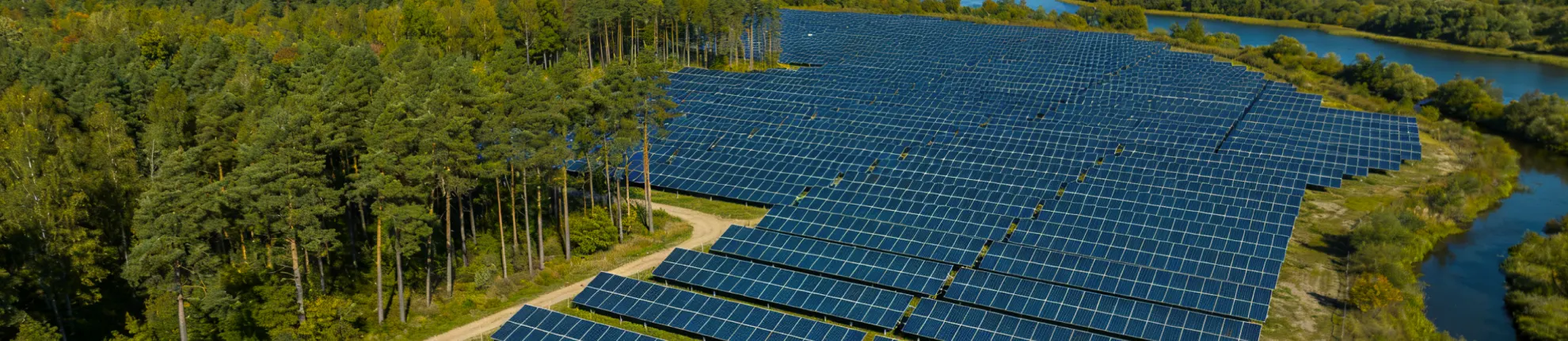
Single-Axis Solar Tracker: How It Works and Key Benefits
Single-axis trackers are usually judged against fixed-tilt racking by the extra energy they produce. That gain varies from site to site. The share of direct sunlight, the slope of the ground and the site's wind exposure change how much a tracker row produces and what it costs to build and operate. A project developer or design engineer comparing mounting options has to weigh the energy against the cost.
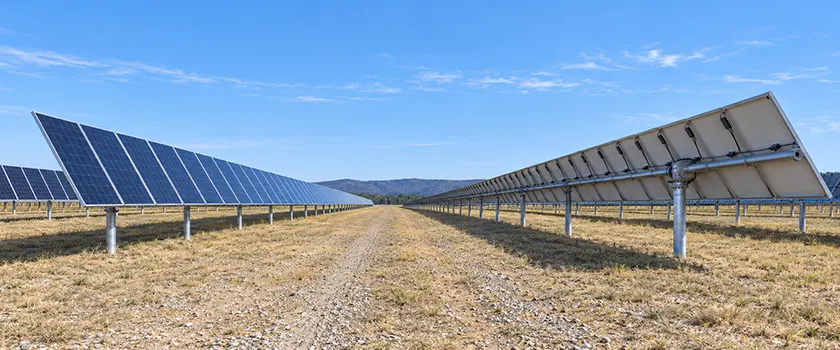
A single-axis solar tracker rotates rows of PV modules about one axis, usually aligned north to south, so they follow the sun from east to west. Its controller sets the angle from the calculated sun position and backtracks at low sun angles to limit row-to-row shading. A 2019 study co-authored by NREL and Sandia researchers cites a 15% to 25% energy gain over fixed-tilt systems in regions with high direct normal irradiance. The gain shrinks where diffuse light dominates. Added cost, maintenance and wind design also make the choice site-specific.
Table of Contents
- How Does a Single-Axis Solar Tracker Work?
- Main Components of a Single-Axis Tracking System
- Key Benefits of Single-Axis Solar Trackers
- Single-Axis Tracker vs Fixed-Tilt and Dual-Axis Systems
- Limitations and Trade-Offs of Single-Axis Trackers
- When Does a Single-Axis Tracker Make Sense for a Project?
- Get a Single-Axis Tracker Layout and Quote for Your Site
- Frequently Asked Questions
How Does a Single-Axis Solar Tracker Work?
In a single-axis solar tracking system, each row of modules is mounted on a long steel tube called a torque tube, which usually runs north to south. The tube rests on bearings fixed to steel posts, most often driven piles, and a drive rotates it through the day. As it turns, the modules face east in the morning and west in the afternoon.
This is a horizontal single-axis tracker (HSAT), the type used on most large ground-mounted plants and the one this article describes. Tilted-axis and vertical-axis trackers are less common.
The Daily Tracking Cycle
The controller calculates the sun's position from the date, time and site coordinates, then commands the drive to turn the row to the target angle. An inclinometer or other angle sensor reports the actual angle, and the controller corrects any position error. The drive moves the row in small steps, either at fixed intervals or once the target angle has changed by a given amount. At night the row parks at a preset angle. When wind speed exceeds a threshold, it moves to a protective angle known as the stow position.
Backtracking and Row-to-Row Shading
Early and late in the day, a row tilted steeply toward the low sun casts a long shadow onto the next row. In a crystalline silicon module the cells are wired in series strings, so a shadow over a few cells limits the current through the rest of the string. The power lost can be far larger than the shaded area would suggest.
Backtracking is a control strategy that turns each row back toward flat when the sun is low, so that one row does not shade the next. During backtracking the row is held at a larger angle of incidence, the angle between the sunlight and a line perpendicular to the module. It gives up some direct-beam energy for part of the morning and evening, though usually less than shading would have cost.
The row pitch marked in the figure is the distance between adjacent rotation axes. Dividing the width of the module surface across the row by the pitch gives the ground coverage ratio (GCR). A higher GCR means tighter rows, and backtracking lasts longer each morning and evening.
The standard backtracking calculation assumes neighboring rows sit at the same elevation. NREL (now the National Laboratory of the Rockies) extended it to sloped sites in a 2020 technical report, an approach usually called slope-aware backtracking. It matters on sites that slope across the rows, where the standard calculation leaves some row-to-row shading.
Main Components of a Single-Axis Tracking System
The main components of a single-axis tracker row are the torque tube, the drive, the controller and its sensors, the bearing assemblies and the piles.
| Component | What It Does | Design Factors |
|---|---|---|
| Torque tube | Carries the modules and transmits torque along the row | Torsional stiffness and the row's response to wind |
| Drive (slew drive or linear actuator) | Turns the torque tube. A slew drive is a gear drive that rotates the tube directly | Number and arrangement of drives, which affect cost and maintenance access |
| Controller and sensors | Calculates the target angle, checks the row angle against it and reads wind speed from an anemometer | Tracking, backtracking and stow behavior |
| Bearing assemblies | Support the torque tube on the piles and let it rotate | How much pile misalignment the row can accommodate |
| Piles | Carry wind, snow and dead loads into the ground | Embedment depth, installed height and vertical alignment |
Key Benefits of Single-Axis Solar Trackers
At suitable sites, single-axis tracking raises energy per installed watt, broadens the daily generation profile and lowers the levelized cost of energy.
Higher Energy Yield per Installed Watt
A fixed module tilted toward the equator comes closest to facing the sun for a short time around solar noon. A tracked module keeps a much smaller angle of incidence through the morning and afternoon. Direct-beam irradiance on the module surface scales with the cosine of that angle, so a smaller angle means more output in those hours.
Most of the gain comes from direct sunlight, measured as direct normal irradiance (DNI) on a surface facing the sun. Diffuse light, scattered by the atmosphere, reaches the module from the whole sky, and how much the module collects depends far less on its angle. Tracking adds less where diffuse light dominates.
In regions with high DNI, a 2019 study co-authored by researchers at NREL and Sandia National Laboratories puts the gain over fixed-tilt systems at 15% to 25%. Operating plants in the United States show the same pattern. Berkeley Lab's 2025 data update on U.S. utility-scale PV reports that single-axis tracking adds more than five percentage points to AC capacity factor in the regions with the strongest solar resource. The improvement is smaller where the solar resource is weaker.
A Broader Daily Generation Profile
On a clear day, output from a tracked row climbs faster in the morning and stays high later into the afternoon. The daily curve is flatter than a fixed-tilt array's, so inverter and interconnection capacity are used over more hours of the day.
Whether the broader profile adds revenue depends on your tariff or power purchase agreement (PPA). In markets with higher late-afternoon prices, more of a tracker's output is sold at those prices.
Where Tracking Lowers the Levelized Cost of Energy
Levelized cost of energy (LCOE) is the lifetime cost of a project divided by the energy it delivers over that life, with both discounted to present value. A tracker adds equipment, installation and maintenance costs and increases energy yield.
LCOE falls when lifetime energy rises by a larger percentage than lifetime cost. The same tracker can therefore lower LCOE at one site and raise it at another.
Single-Axis Tracker vs Fixed-Tilt and Dual-Axis Systems
Single-axis tracking sits between fixed-tilt racking and dual-axis tracking in energy yield, moving parts and upkeep. Dual-axis trackers add a second rotation axis to raise yield per module further, at the cost of more mechanisms to buy and maintain.
| Dimension | Fixed-Tilt | Single-Axis Tracker | Dual-Axis Tracker |
|---|---|---|---|
| Energy per module | Baseline | Higher where direct sunlight dominates | Usually the highest per module |
| Components and installed cost | No drives, controllers or bearings | Adds drives, controllers and aligned bearings. Installed cost depends on site and market | Usually the highest of the three |
| Terrain | Adapts to slope through foundation and structure height | Slope tolerance set by the tracker design | Each unit sits on its own foundation, so slope is handled unit by unit |
| Typical use | Rooftops, plus ground-mounted sites with difficult terrain, high wind, high latitude or limited land | Large ground-mounted plants | Niche sites where the extra yield per module justifies the cost |
If your site is steeper than the tracker's slope tolerance, it needs grading or a terrain-following tracker design, and the value of the extra energy has to cover that cost.
Limitations and Trade-Offs of Single-Axis Trackers
Most of the trade-offs trace back to the moving parts and to protecting the rows in high wind and hail.
Cost, Installation Tolerances and Maintenance
A tracker row needs drives, controllers, torque tubes and bearings that a fixed-tilt row does not. The bearings along one torque tube also need to line up, so the piles have to be installed to a tighter tolerance. If pile heights or alignment along a row fall outside it, the tube binds in the misaligned bearings, the drive needs more torque to turn the row, and its overload protection can trip before the row reaches the target angle. Pile type affects the installation work needed to meet that tolerance. The guide to foundation types for ground-mount solar systems covers the options.
Trackers need more maintenance than fixed-tilt racking, because the drives, bearings and controls all have to be checked periodically. When a drive or controller stops responding, the affected rows stay at their last angle until the fault is cleared. The energy you lose depends on that angle, the time of day and the length of the outage.
Wind and Hail Stow
Piles support a tracker row every few meters, but the row is held against rotation only at its drive points. That makes a long row stiffer in bending than in torsion. In high wind the controller moves the rows to their stow position. Some designs stow flat, parallel to the ground, and others stow at a tilt.
The choice between them is partly a question of stability. In a 2015 wind-tunnel and simulation study, CPP Wind Engineering found that vortices shedding from the windward edge of a flat-stowed row can set off torsional galloping, a twisting motion that builds on itself. The authors concluded that the instability can be avoided at typical non-hurricane design wind speeds through a combination of stow strategy, damping and torsional stiffness.
Trackers that offer hail protection use a separate stow position. VDE Americas' 2024 technical memo describes rotating the modules to the tracker's maximum tilt, roughly 50 to 75 degrees, so that less glass is exposed and hailstones strike at a glancing angle. The memo recommends that hail stow take priority over wind stow where the tracker manufacturer allows it.
When Does a Single-Axis Tracker Make Sense for a Project?
The test is whether the extra energy is worth more than the added cost over the life of the project.
| Factor | Favors a Tracker | Needs Closer Review | Why It Matters |
|---|---|---|---|
| Direct sunlight share and latitude | High direct normal irradiance, clear skies, low to mid latitudes | Frequent cloud or haze, high diffuse share, high latitudes | The tracking gain comes mainly from the direct beam |
| Terrain | Level or gently sloping ground within the tracker's slope tolerance | Steep or uneven ground, or slope across rows beyond the tolerance | Terrain affects earthwork cost, row layout and backtracking settings |
| Land and row pitch | Enough land for a moderate ground coverage ratio | Tight sites that need high ground coverage | Tight pitch keeps the rows backtracking for more of the day, which trims the gain |
| Wind and snow | Moderate design wind speed and snow load, well within the tracker's rated limits | Design wind speed or snow load close to the tracker's rated limits | Stow strategy, wind testing and clearing snow between rows add design and operating work |
| Offtake terms and grid | Prices that reward extra energy or afternoon output | Export limits or curtailment that cap the extra energy | Added energy has value only if it can be used or sold |
Latitude is only a rough guide to the share of direct sunlight. Researchers at Purdue University modeled tracked and fixed-tilt bifacial solar farms worldwide in a 2021 study. Within 30 degrees of the equator, their model showed single-axis tracking producing 25% to 45% more energy per year than fixed-tilt racking. The gain was smaller at higher latitudes, where diffuse light makes up more of the sunlight. At those latitudes, keep fixed-tilt racking in the comparison.
Get a Single-Axis Tracker Layout and Quote for Your Site
Mibet supplies single-axis solar trackers for ground-mounted PV projects. Our engineering team uses your site data to work out the row layout and pitch and to check ground slopes against the tracker's slope tolerance. Pile sections and embedment depths are designed to the governing local code during detailed engineering.
Send us the project location, target DC capacity and module model, plus any topographic survey, geotechnical report and design wind and snow loads you have. You will receive a preliminary tracker layout and a budgetary quote.
Frequently Asked Questions
1. How much more does a single-axis tracker cost than fixed-tilt racking?
There is no single premium. Tracker components, foundations, site preparation, project size and market all move the figure.
As a reference point, NREL's Q1 2021 cost benchmark modeled a 100 MW U.S. utility-scale plant. The installed cost of the whole plant came to $0.83 per watt DC with fixed-tilt racking and $0.89 with single-axis tracking, about 7% more. Those figures cover one plant size, one market and 2021 costs. For your project, compare quotes for both options based on the same site data.
2. Can bifacial modules be used on single-axis trackers?
Yes. A 2019 paper by NREL and Sandia researchers reports that bifacial modules on single-axis trackers add 4% to 15% to energy yield over monofacial modules on the same trackers. The gain varies with module type and ground albedo (how much light the ground reflects).
Because rear-side gain depends on row spacing, module height and rear shading, bifacial gain and tracking gain are calculated together in one energy model.
3. Do single-axis solar trackers work on cloudy days?
Yes. A standard controller follows the calculated sun position and keeps tracking under cloud cover. The gain is smaller, because cloud scatters most of the light. Some controllers respond to overcast skies by turning the rows closer to flat, where the modules see more of the sky.
4. What happens when a single-axis solar tracker loses power?
A tracker that loses drive power stays at its current angle. The effect of a grid outage depends on the tracker's power source.
A self-powered tracker, with a dedicated PV module and battery at each drive, keeps working through a grid outage. A tracker fed from the plant's AC supply stops when that supply is lost, unless a backup power unit is fitted to move the rows to their stow position.
5. What routine maintenance does a single-axis tracker need?
Routine work centers on the drive, bearings and controls. Typical tasks include torque checks on drive and structural bolts, lubrication of any gearbox or bearing that needs it, and inspection or calibration of the anemometer, inclinometer and limit switches. Intervals depend on the manufacturer's recommendations and on site conditions.
6. Can a fixed-tilt array be converted to a single-axis tracker later?
Converting a fixed-tilt array to a single-axis tracker means rebuilding the mounting structure. Foundations and row pitch differ between the two, and a fixed-tilt row has no torque tube, bearings or drive. Existing modules can be reused only if their dimensions, weight, frame and mounting zones meet the tracker's requirements.
Sources used for this article are listed below.
- Slope-Aware Backtracking for Single-Axis Trackers, NREL/TP-5K00-76626, 2020.
- Model and Validation of Single-Axis Tracking with Bifacial PV, IEEE Journal of Photovoltaics, 2019.
- Berkeley Lab, U.S. Utility-Scale Solar, 2025 Data Update.
- CPP Wind Engineering, Torsional Instability of Single-Axis Solar Tracking Systems, 2015.
- VDE Americas, Best practices for hail stow of single-axis tracker-mounted solar projects, 2024.
- Global analysis of next-generation utility-scale PV: Tracking bifacial solar farms, Applied Energy, 2021.
- U.S. Solar Photovoltaic System and Energy Storage Cost Benchmarks: Q1 2021, NREL/TP-7A40-80694.

Tao Chen
Marketing Director & IT Director · MIBET ENERGY
MIBET is a global designer and manufacturer of solar mounting systems. With over 10 years of professional experience, Tao Chen regularly contributes articles to our blog on structural design, installation, and maintenance, offering valuable guidance for navigating the complexities of solar projects.