How Solar Ballast Systems Avoid Penetrations on Membrane Roofs
A non-penetrating mounting system keeps structural anchors out of the membrane. The array still has to resist uplift, sliding, and overturning, and the ballast that supplies part of that resistance also adds dead load and local bearing pressure to the roof build-up. Wind design, available roof capacity, the contact materials at the membrane, and the warranty on your existing roof all feed into the same decision.
Solar ballast systems secure the PV array without primary structural anchors through the roof membrane. Module weight, rack weight, and added ballast resist uplift and overturning, and friction at the roof interface resists sliding. Array geometry changes the wind pressure acting on the panels, and load sharing across connected racks changes how that load is distributed. The layout has to match site wind loads, roof slope, membrane attachment, structural capacity, contact materials, and drainage conditions. Non-penetrating mounting reduces the number of waterproofed structural connections. It does not remove the need for project-specific engineering, insurer review, or roofing-manufacturer approval.
Table of Contents
- What Is a Solar Ballast System for a Membrane Roof?
- How Ballasted Mounting Secures the Array Without Roof Penetrations
- Which Membrane Roofs Are Suitable for Ballasted Solar Mounting?
- What Determines Ballast Weight and Array Layout?
- What Project Data Is Needed for an Engineered Ballast Plan?
- Mibet Provides Ballast Plans for Membrane Roof Solar Projects
- Frequently Asked Questions
What Is a Solar Ballast System for a Membrane Roof?
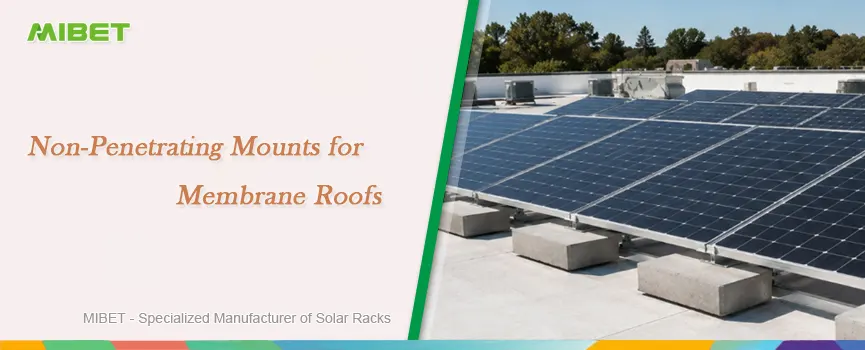
A membrane roof solar ballast system supports photovoltaic modules on low-profile racks above the waterproofing layer. Concrete pavers, also called ballast blocks, sit in ballast trays or in designated positions on the racking, and their weight does the work that anchors would otherwise do.
The term non-penetrating applies to the primary mounting method, meaning the connection between the racking and the building structure. Conduits, electrical equipment, fall-protection anchors, and hybrid attachment points may still require separately flashed roof penetrations.
The word ballast covers two different things on a roof-PV project. A ballasted roof assembly uses stone or concrete pavers to hold the roofing membrane in position, and that choice belongs to the roofing scope, settled before any solar equipment enters the project. A solar ballast system holds the PV mounting structure in position, and the membrane keeps whatever attachment method it already has. On an existing roof ballasted with concrete pavers, a PV array may still be feasible, subject to roof and structural review.
Roofs ballasted with loose aggregate need separate review. FM Data Sheet 1-15 advises against installing PV on roofs with aggregate, or where an adjacent higher roof has aggregate, because loose stone can become windborne debris and pedestals bearing on aggregate change the sliding resistance the calculation depends on.
How Ballasted Mounting Secures the Array Without Roof Penetrations
Four mechanisms keep a ballasted array in position, and they do not all work in the same way. System weight and interface friction supply resistance. Array geometry changes the wind pressure acting on each module, and the connections between racks change how an applied load spreads across neighboring units.
Ballast Weight Resists Uplift and Overturning
Wind creates pressure above and below a solar module. The net upward component is wind uplift. The same flow creates an overturning moment that tends to rotate the rack about one of its support edges.
The combined weight of modules, racking, and ballast counters both actions. How much resistance a support needs changes across the roof. Supports near roof corners, roof edges, array boundaries, gaps, and access aisles face different demands from supports located within the array interior.
An access aisle interrupts the continuity between connected racks, which reduces load distribution and removes the shielding that outer panels give to the ones behind them. For panels immediately around openings of that kind, FM recommends additional ballast or securement, typically on the order of 50 percent more.
Adding ballast raises resistance. It also raises structural load and local bearing pressure at every support that carries it. Engineers therefore assign ballast by roof and array zone, based on the local wind demand and the structural capacity available.
Friction Limits Horizontal Sliding
Friction between the mounting base and the roof surface resists horizontal movement. The coefficient depends on the exact material pair at that interface, typically a pedestal pad or slip sheet in contact with a TPO, PVC, or EPDM surface. A slip sheet is the thin sacrificial layer installed between the rack base and the membrane. Changing either contact surface changes the applicable coefficient.
ASTM D1894-24 provides the test method for static and kinetic coefficients of friction between plastic film or sheeting and another surface. Results shift with material age, surface condition, temperature, moisture, and the test procedure itself, so a coefficient taken from a product datasheet may not represent the installed material pair. FM Data Sheet 1-15 handles that variability by taking the lesser of the wet and dry tested values and limiting the assumed static friction coefficient to 0.4 unless testing justifies a higher figure. Those limits belong to the FM framework and do not govern every project or jurisdiction.
The sliding calculation should use friction data for the materials that will actually be installed, including the slip sheet. Changing the contact material later can invalidate that data, unless the substitute is covered by equivalent test results or written engineering approval.
Array Geometry Changes Wind Pressure
Module tilt, orientation, row spacing, edge gaps, parapet height, and wind deflectors all change the airflow around an array. A layout with lower wind demand can be held with less ballast, provided it stays inside the configuration range the pressure coefficients came from.
Deflectors show the effect clearly. In wind-test terminology, fitting deflectors on the high side of each row turns an open array into a closed configuration, and the two carry different pressure coefficients. Switching a module from portrait to landscape alters the rack geometry. A larger module, a higher tilt, a shorter connected row, or a different edge gap can also change the applicable pressure coefficients or the structural assumptions behind the original calculation.
Connected Rows Share Loads
Rails, braces, module connections, and rack-to-rack connectors transfer part of an applied load into neighboring units. Engineers call that behavior load sharing. Validated load sharing can reduce local ballast demand in some configurations by spreading wind action across connected racks.
A physical connection on its own does not establish how much of that sharing a design may credit. The amount depends on rack stiffness, connector strength, array dimensions, module arrangement, and ballast placement. The value must be supported by test data or structural analysis accepted under the governing design method.
| Stability Mechanism | What It Does | Main Influencing Factors |
|---|---|---|
| System weight | Resists uplift and overturning | Module weight, rack weight, ballast distribution |
| Interface friction | Resists horizontal sliding | Contact materials, surface condition, roof slope |
| Array geometry | Changes the wind pressure acting on the panels | Tilt, orientation, row spacing, deflectors, parapets |
| Load sharing | Spreads wind action across connected units | Rack stiffness, connectors, array size, tested configuration |
Wind demand and the available resistance both vary across the roof, so the final drawing should give ballast quantities zone by zone.
Which Membrane Roofs Are Suitable for Ballasted Solar Mounting?
TPO, PVC, EPDM, and some modified-bitumen assemblies all carry ballasted solar arrays. What decides your case is the rest of the assembly: how the membrane is attached, what sits underneath it, and how much service life it has left.
Membrane Attachment Limits the Mounting Method
Attachment method is worth confirming early, because under some approval frameworks it settles whether a fully ballasted layout is permitted at all.
A fully adhered membrane is bonded continuously to the substrate below. A mechanically attached membrane is secured at spaced fastener rows and can move between them as pressure changes, a behavior called billowing. Rigid wind-tunnel models do not reproduce that movement, and vertical movement of the roof cover can raise the drag and lift coefficients acting on the panels. New ballasted PV systems within the FM framework are therefore limited to adhered roof membranes, and PV installed over a mechanically fastened roof cover must be mechanically fastened as well. Other jurisdictions and approval routes apply their own criteria, so confirm which framework governs your building before layout work starts.
Contact Materials Must Match the Roof Membrane
TPO and PVC are thermoplastic membranes. EPDM is a thermoset synthetic rubber. Each responds differently to prolonged contact with plasticizers, oils, rubber compounds, heat, and surface treatments, so compatibility should be checked for the specific membrane product and the proposed contact material.
A slip sheet or protection layer separates the rack base from the membrane, limits abrasion, and keeps incompatible materials apart over years of contact. The selected layer should be approved by the membrane manufacturer and match the interface used in the sliding calculation.
Roof Age Changes the Project Sequence
Check an existing roof for leaks, open seams, blisters, previous repairs, trapped moisture, and remaining service life before solar modules restrict access to it. FM Data Sheet 1-15 recommends replacing or re-covering a roof more than 10 years old before adding a PV system expected to remain in service for 25 to 30 years, and advises against installing PV over roofs showing leaks, cracks, delamination, or blisters. Outside an FM-governed framework, roof condition, remaining service life, warranty status, and the requirements of the roofing manufacturer and project engineer determine whether replacement or re-covering comes first.
A solar-ready roof should also carry a remaining warranty period that broadly matches the expected service life of the PV system. If the roof needs replacing inside that period, the array will have to be removed and reinstalled, which adds cost and lost production to a plant that is already running.
Roof slope and surface condition, cover-board type and thickness, insulation compressive resistance, roof-deck type and condition, drainage layout, parapets and rooftop equipment, and allowable structural loading all form part of the same review. Together these conditions decide whether a ballasted layout is suitable, and they supply the inputs for the ballast calculation.
What Determines Ballast Weight and Array Layout?
There is no standard ballast weight that applies across projects. The required quantity depends on site wind conditions, building geometry, roof characteristics, module configuration, racking, and the applicable wind-design data. Until those inputs are confirmed, any figure a supplier gives you is suitable for preliminary budgeting only.
The calculation follows the structural standards that apply to the project. ASCE/SEI 7-22 provides the U.S. framework for wind, snow, rain, seismic, dead-load, and load-combination calculations, and projects elsewhere work from the applicable national or local standard. Insurer criteria can add requirements beyond the code minimum and change the resulting ballast demand. FM wind design for these systems applies an importance factor of 1.15 and a safety factor of 2.0 on each panel, and assumes Ground Roughness C unless all conditions for Exposure B or D are met and documented.
The main design inputs connect as follows:
| Design Input | Engineering Relationship | Project Impact |
|---|---|---|
| Basic wind speed and exposure | Establish external wind demand | Affect uplift, sliding, and overturning |
| Building height and dimensions | Change pressure distribution across the roof | Affect roof-zone boundaries |
| Parapet geometry | Changes airflow near roof edges | May raise or lower local demand |
| Roof and array position | Identifies interior, edge, and corner conditions | Produces a zone-specific ballast schedule |
| Roof slope | Adds downhill force and reduces normal force | Changes sliding resistance |
| Tested interface friction | Quantifies horizontal resistance | Affects required ballast |
| Roof structural capacity | Limits added dead load | May require layout or attachment changes |
| Snow and seismic conditions | Add vertical or horizontal actions | May change the mounting method |
| Module dimensions and orientation | Change aerodynamic area and rack geometry | Affect wind-data applicability |
| Tilt and row spacing | Change pressure around the modules | Affect layout and ballast demand |
| Rack stiffness and load sharing | Spread load between connected units | Affect the wind load used in design |
Roof Zones and Array Zones Are Different
Wind pressure rises near building edges and corners, so roof calculations divide the surface into interior, edge, and corner zones. A solar array has its own interior, edge, and corner positions. The roof zones and the array zones overlap, but their boundaries are not the same, and an exposed module at an array corner near a roof corner carries a different wind demand from an interior module near the middle of the building.
Where a design relies on wind-tunnel data, the applicable report defines both classifications for the tested configuration. A boundary layer wind tunnel study prepared under ASCE 49 should supply the pressure coefficients and the zoning for the tested array configuration. It also needs to state the limits on panel slope, building geometry, and roof slope, the edge and parapet factors, and the load sharing factor used. For an FM-based design, missing configuration limits or load-sharing information can prevent a report from being used for your layout.
Many racking systems are already supported by wind-tunnel data covering a defined range of buildings, modules, tilts, and array geometries. The project team then checks whether the building and layout fall within that tested range, rather than commissioning a new study. Prescriptive methods are also available within the limits set by the governing standard.
Structural Capacity Limits the Available Ballast
Structural capacity should be evaluated by a qualified structural engineer working from the project structural drawings and calculations. The review covers:
- Module and rack dead load
- Added ballast
- Local bearing pressure
- Installation and maintenance loads
- Applicable snow, rain, and other load combinations
For a first-pass screening on an existing roof, FM suggests allowing 2 to 3 psf (0.10 to 0.14 kPa) for the PV panels and their hardware, plus the calculated ballast, while confirming that the added dead weight does not reduce the capacity available for snow, rain, and live loads below the required level. That figure is a screening value. Actual equipment weights and project calculations govern the design.
If the calculated ballast exceeds the available roof capacity, the layout or the mounting method has to change. Tilt, module orientation, array boundaries, rack connections, and deflector arrangement all change wind demand and the resulting ballast requirement. A hybrid layout can use structural attachments in the higher-demand zones and keep ballast where structural capacity allows.
What Project Data Is Needed for an Engineered Ballast Plan?
A ballast schedule is assembled from building geometry, environmental loads, roof information, module data, and installation constraints. Roof area and target capacity are useful starting points, and they are not enough on their own to calculate a buildable ballast schedule.
| Information Needed | How It Is Used |
|---|---|
| Site location and applicable code | Sets the design basis |
| Building height and dimensions | Define wind exposure and the zone plan |
| Roof drawing and parapet dimensions | Map the usable area and edge conditions |
| Membrane type and attachment method | Confirm the mounting method and interface requirements |
| Roof build-up and allowable loads | Check structural and bearing limits |
| Cover board and insulation data | Set support and interface details |
| Module model, dimensions, and frame | Match the rack and the tested configuration |
| Tilt, orientation, and target capacity | Set the module and row layout |
| Drains, equipment, and setbacks | Keep access and drainage clear on the installation drawing |
| Applicable wind-design data and validated interface friction | Used with the available resistance to calculate the zone-specific ballast schedule |
Most of this information comes from you, your EPC team, or the building design team. The mounting engineer then applies the governing wind criteria and the validated interface-friction data to produce the ballast schedule.
Mibet Provides Ballast Plans for Membrane Roof Solar Projects
The Mibet engineering team develops project-specific ballasted solar mounting plans from the confirmed roof, building, and module data. The engineering package identifies the location of each rack and ballast block, the roof and array zones used in the calculation, and the module dimensions, interface materials, and layout conditions that must remain consistent through procurement and installation.
To begin a project-specific review, send the project inputs listed in the table above.
Frequently Asked Questions
1. Do ballasted solar systems require any roof penetrations?
Ballasted solar systems avoid structural penetrations for the primary module and racking assembly. System weight and added ballast resist uplift and overturning, interface friction resists sliding, and array geometry and load sharing affect the wind demand and how it is distributed across connected racks.
Electrical conduits, rooftop equipment, fall-protection anchors, and hybrid attachment points may still require separately flashed roof penetrations.
2. Can ballasted solar mounting be installed on TPO, PVC, and EPDM roofs?
Yes, under suitable project conditions. Suitability depends on the complete roof assembly, including membrane attachment, roof condition, insulation and cover-board capacity, roof slope, structural loading, and warranty requirements.
Membrane attachment comes first under the FM framework, because a mechanically attached roof cover changes the permitted mounting approach.
3. How much ballast does a membrane roof solar system need?
There is no standard ballast weight per module or per square foot. The quantity comes out of site wind conditions, building geometry, parapets, roof and array zones, module tilt, interface friction, roof slope, rack load sharing, and structural capacity.
4. Do you need a wind tunnel test for a ballasted array?
Not in every case. Under the FM framework, the wind design of a ballasted system may be based on a valid boundary layer wind tunnel report, together with two separate supporting documents: a qualified third-party peer review of that report, and load-sharing documentation such as a vertical load test.
Many racking systems are already supported by wind-tunnel data covering a defined range of buildings, modules, and array geometries, so the project team confirms whether the layout falls within that range. Prescriptive ASCE/SEI 7-22 methods may also be used within their stated limits. The choice affects engineering cost, schedule, and documentation requirements.
5. Can ballasted mounting be used in seismic areas?
Yes, within defined limits. ASCE/SEI 7-22 Section 13.6.12 permits unattached arrays once a defined set of conditions is met. Those conditions cover risk category, building height, roof slope, panel center-of-mass height, seismic displacement of the array and its cabling, and appropriate friction data, including cold-weather effects where applicable. The displacement itself is established by a prescriptive procedure, nonlinear response history analysis, or shake table testing, depending on what the governing criteria accept.
Where those criteria are not satisfied, positive attachment to the structure may be required. Additional ballast increases friction, and it also increases seismic mass and the resulting force, so it cannot be assumed to replace anchorage.
6. Can ballast blocks damage a roof membrane?
Yes. Incompatible contact materials, concentrated bearing pressure, repeated movement, and poor drainage can all damage or overstress the membrane.
An approved slip sheet or protection layer, an adequate bearing area, a stable rack arrangement, and a coordinated roof build-up reduce abrasion and compression. The installed interface material should also match the friction data used in the sliding calculation.
7. Does a non-penetrating solar system preserve the roof warranty?
Not by itself. Warranty status depends on the existing roof condition, the membrane manufacturer, contact materials, installation method, access provisions, the inspection process, and the required documentation. Procedures vary by manufacturer, and pre-approval, inspections, documentation, or repairs may all be required.
The roofing manufacturer or warranty provider should review the proposed mounting arrangement before the layout and installation details are finalized.
Here is a list of the sources used to create this article.
- FM Data Sheet 1-15, Roof-Mounted Solar Photovoltaic Panels. FM, 2026.
- ASTM D1894-24, Standard Test Method for Static and Kinetic Coefficients of Friction of Plastic Film and Sheeting. ASTM, 2024.
- ASCE/SEI 7-22, Minimum Design Loads and Associated Criteria for Buildings and Other Structures. ASCE, 2022.
- ASCE/SEI 49-21, Wind Tunnel Testing for Buildings and Other Structures. ASCE, 2021.
- U.S. Department of Energy, Better Buildings Alliance. Commercial Rooftop Solar: Frequently Asked Questions. 2015.

Tao Chen
Marketing Director & IT Director · MIBET ENERGY
MIBET is a global designer and manufacturer of solar mounting systems. With over 10 years of professional experience, Tao Chen regularly contributes articles to our blog on structural design, installation, and maintenance, offering valuable guidance for navigating the complexities of solar projects.