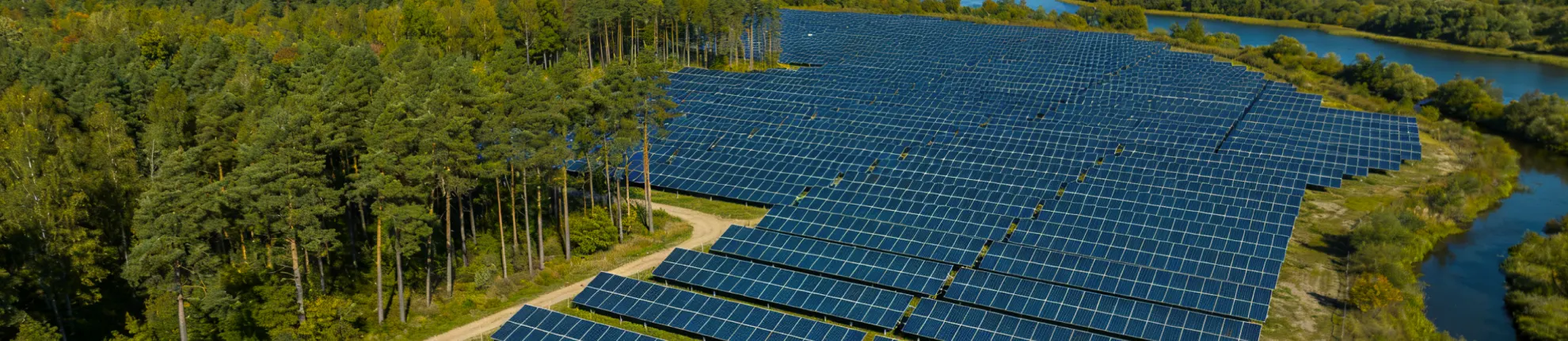
Mibet Introduces G7 Floating Solar System with Portrait Module Layout
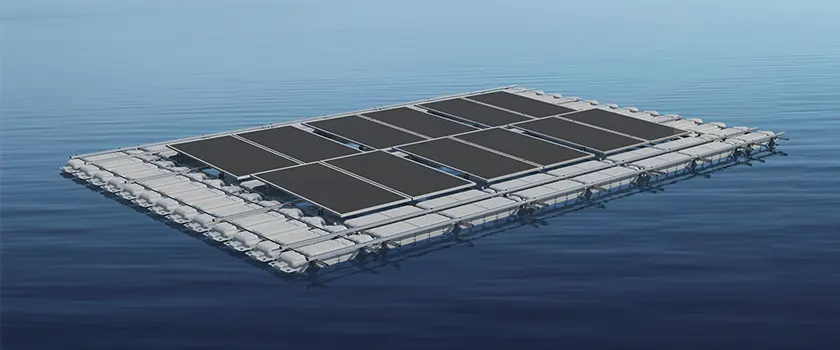
Mibet has introduced G7, a floating solar mounting system that holds modules in portrait orientation instead of landscape. On a floating array, maintenance walkways take up a sizable share of the array's footprint. Leaving them out between some rows saves space, but the modules in those rows become harder to reach.
Every module row in G7 still has a walkway along its front and rear edges. Even so, in a 36-module reference layout, G7 needs about 14% less water area than our previous landscape layout, with walkways and perimeter floats counted in both.
Why G7's Portrait Layout Needs Less Water Area
Walkways run between module rows, so the number of walkways follows the number of rows. In a landscape layout, each module's long side runs along the row, which limits how many modules a row of a given length can hold. In portrait, the short side runs along the row. Each row holds more modules, and the same number of modules fits into fewer rows with fewer walkways between them.
On a large reservoir, that saving can mean more capacity on the same water area, or the same capacity on a smaller footprint.

In the G7 layout, the junction boxes of neighboring modules also sit closer together, so the cable connection between them is shorter. The shorter connections use less cable and, at the same cable size, lose less power to resistance.
A Main Float with Three Rails
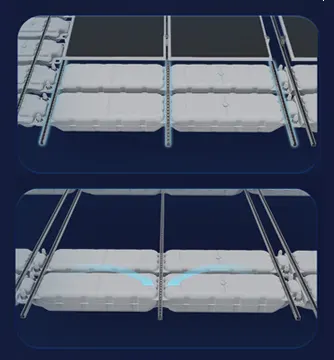
Our earlier floats carried two rails. The G7 main float carries three C-channel rails, and neighboring modules share the one in the middle. Sharing it cuts down on support parts and lets the modules sit closer together.
The center slot is deeper than the two outer slots, and the center rail is taller by the same amount. All three rail tops are flush. The shared rail is on the float's centerline and carries load from both neighboring modules.
Across the array, G7 packs about 19% more float buoyancy into each square meter than our previous floating system.
How the Modules Are Mounted
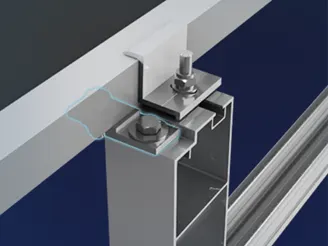
Each module sits on short front legs and taller rear legs, all bolted to the rails. The legs are made to the tilt specified for each project, from 3° to 15°.
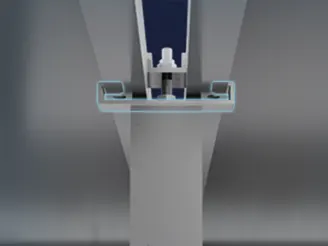
Clamps press the module frame down from above, and a support plate fastened to each leg holds the frame from below. A stop at the top of each leg keeps the module in place while the crew installs the clamps. No separate anti-slip parts are needed.
Float and Connection Testing
G7 floats and connections passed the following tests under NB/T 10187-2019, China's energy industry standard for floating PV floats:
- Single-lug vertical pull test
- Diagonal and opposite-side pull tests
- Top-surface compression test
- Drop and ball impact tests
- Airtightness and watertightness tests
- Bolt-and-nut assembly test
Key Specifications
| Parameter | G7 |
|---|---|
| Module orientation | Portrait |
| Tilt angle | 3°–15° |
| Design wind speed | 60 m/s |
| Compatible modules | Large-format framed monofacial and bifacial modules |
| Materials | HDPE floats and connecting bolts, Zn-Al-Mg coated steel, anodized aluminum parts, 304 stainless steel fasteners |
| Typical sites | Lakes and reservoirs |
Planning a Floating PV Project?
Water depth and level variation, wind and wave exposure, and your choice of module all shape a G7 layout. Our engineering team plans the array from that information, then checks anchoring, tilt, float arrangement and buoyancy for your site.
Send us your project location, available water area, target capacity, water depth and level records, and module datasheet. We'll come back with a preliminary layout and a budget quote.