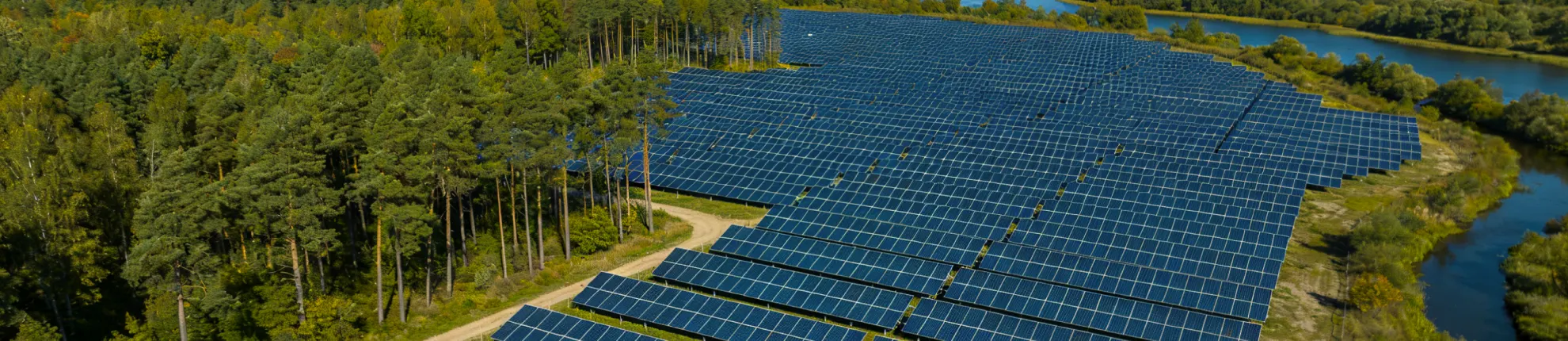
Principles and Advantages of Single-Axis Solar Trackers
Solar modules do their heavy lifting when they catch the sun head-on. But since the sun is a moving target, standard fixed-tilt mounts leave your array off-angle for a large chunk of the day, effectively leaving potential power on the table. Single-axis trackers solve this geometry problem. By actively rotating your panels from East to West to follow the sun's daily arc, they squeeze significantly more yield out of the exact same equipment.
This efficiency boost is why trackers are now the default for utility-scale solar—data from Lawrence Berkeley National Lab indicates they are now deployed on roughly 94% to 96% of new large U.S. projects. Major developers rely on them simply because the ROI is undeniable at that scale. But does that math hold up for you? What works for a massive solar farm doesn't always apply to a commercial site. We’ll break down the mechanics, the real costs, and the operational realities to help you decide if a tracking system actually earns its keep on your project.
What Is a Single-Axis Solar Tracker?
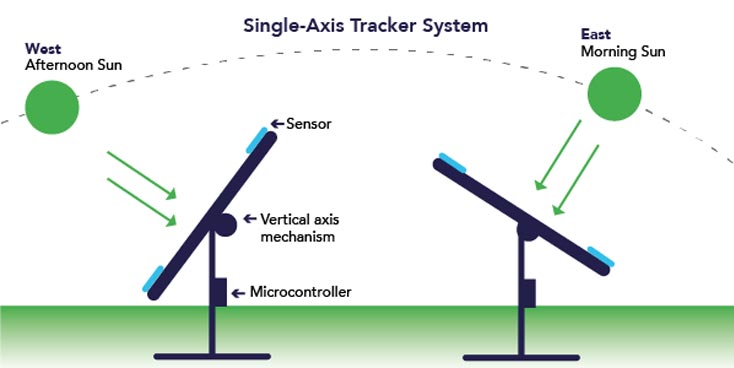
A single-axis tracker actively pivots your solar panels along a fixed axis to follow the sun. Unlike standard fixed mounts that sit frozen in one position, these systems rotate around a North-South axis to chase the sun's path from East to West. This simple mechanical shift keeps your glass perpendicular to the incoming rays, grabbing direct light that a static system would simply miss.
Where They Fit
You will primarily see these systems hard at work on ground-mounted utility projects or large commercial farms. They need room to breathe—specifically, open space to move freely without casting shadows on the row behind them.
But can you put them on your house? Generally, that is a no-go. Installing heavy, moving machinery on a standard rooftop is a structural headache due to weight limits and dynamic wind loads. While niche rooftop options do exist, single-axis trackers thrive in open fields, not on top of shingles.
The Production Payoff
You might wonder if adding moving parts to a 25-year asset is worth the trouble. The numbers suggest it is. You are generally looking at a production boost of roughly 15% to 35% compared to a fixed-tilt rack.
Crucially, this gain doesn't just come from the midday peak; it comes from the "shoulders" of the day. By catching that valuable early morning and late afternoon sunlight, you widen your production window and deliver high power for significantly more hours.
How Single-Axis Trackers Work
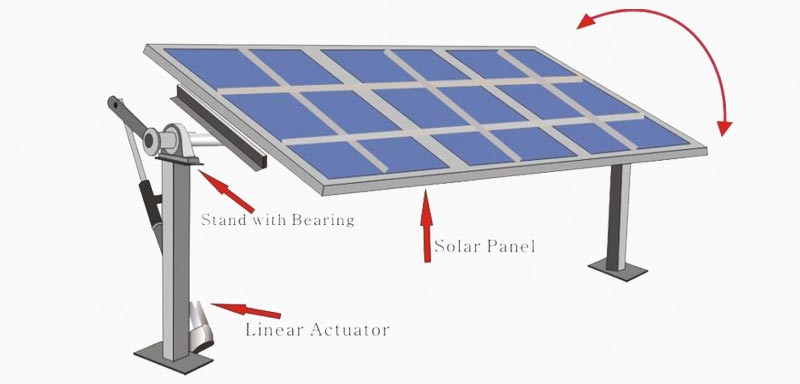
At the most basic level, single-axis trackers operate on a simple rule: keep the angle between your panels and the sun as small as possible to maximize harvest. While the goal is universal, the industry solves this challenge in two very different ways. Let's look at how active and passive systems compare to see which one actually fits your project needs.
Active Tracking Systems: The Industry Standard
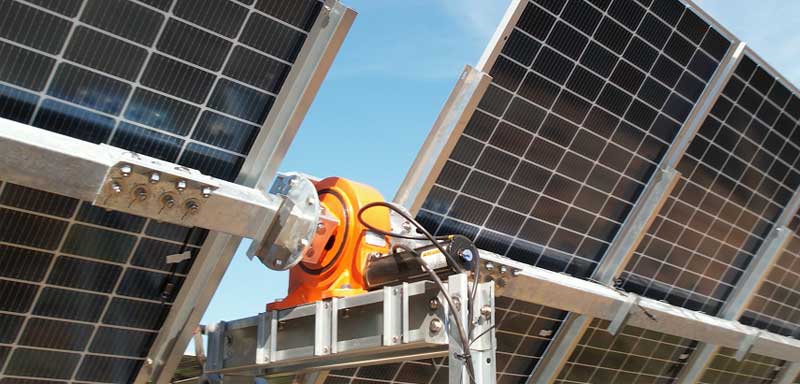
If you are scoping out a modern commercial or utility-scale project, you are almost certainly looking at an active system. These setups act as the "smart muscle" of your solar array. They use electric motors and gears—often robust slewing drives—to physically rotate the panels.
But the hardware is only half the story. The real value lies in how they know where to point.
-
Algorithms over Sensors: We rarely use light sensors to "find" the brightest spot in the sky anymore. The problem was that a passing cloud could confuse them, sending the array hunting for light. Today, controllers rely on astronomical algorithms. By using GPS coordinates and the time of day, the system calculates the sun's exact position mathematically. It knows exactly where the sun should be, regardless of the weather.
-
Smart Backtracking: Here is where the software really earns its keep. In the early morning or late afternoon, long shadows from one row of panels can easily stretch onto the row behind it. A smart controller anticipates this. It intentionally rotates the panels back toward flat—sacrificing a tiny bit of direct angle—to eliminate that self-shading. You give up a fraction of orientation to save the entire string from performance-killing shadows.
-
Self-Protection: These systems are also self-aware. If local anemometers detect high winds, the controller commands the panels to "stow" in a safe position—usually flat or at a specific tilt—to ride out the storm without structural damage.
Passive Tracking Systems: Physics, Not Firmware
Passive trackers are a fascinating feat of engineering because they ditch the motors, gears, and electricity entirely. Instead, they let physics take the wheel.
These systems typically use canisters filled with a volatile fluid, like a refrigerant, on either side of the rack. As the sun heats the canister facing the light, the fluid inside vaporizes and expands, pushing gas to the shaded side. This creates a weight imbalance that acts like a thermal seesaw, tilting the rack to naturally follow the heat source.
Why They Are Rare in Utility Solar
While elegant, passive trackers have trade-offs that usually keep them off modern spec sheets:
-
Slow to Wake Up: On a cold morning, the fluid needs time to heat up before the tracker moves, meaning you miss out on that early generation window.
-
Lack of Precision: Since they rely on heat rather than math, they aren't as precise as active systems. More importantly, they lack the advanced defensive features like backtracking or wind stow modes.
For most developers today, the control and bankability of active systems make them the default choice. Passive units remain a niche solution, mostly suited for smaller, off-grid applications where simplicity outweighs peak performance.
4 Advantages of Single-Axis Solar Trackers
1. A Massive Jump in Energy Yield
The biggest draw is raw power. A single-axis tracker typically boosts annual energy production by 15% to 35% compared to a fixed-tilt system. Data from the solar marketplace EnergySage backs this up, confirming that real-world installations regularly land in that 25–35% sweet spot for performance gains.
This isn't just about getting "more energy"; it is about when you get it. Fixed panels peak only at noon. Trackers widen that window, capturing significantly more sunlight in the early morning and late afternoon. You squeeze more kilowatt-hours out of the exact same hardware, which directly lowers your cost per unit of energy.
2. Higher Production When Rates Are High
Here is where the economics get interesting. In many markets, electricity is most expensive in the late afternoon and early evening—precisely when grid demand spikes as people return home and turn on the AC.
A south-facing fixed panel is already losing steam by then. A tracker, however, is still facing west, actively generating power during these peak hours. If your utility uses Time-of-Use (TOU) rates, this is a major financial win. You aren't just generating more electricity; you are generating more valuable electricity, selling into the grid when prices are at their highest.
3. Better Land Use Efficiency
Trackers allow you to do more with less land. Since each panel works harder, you can hit your energy targets with fewer modules or a smaller footprint.
This density is crucial if you are facing high land costs. Even in tight spaces, modern trackers use smart backtracking algorithms to prevent rows from shading each other. It ensures you get the absolute most out of every square meter you lease or buy.
4. Proven Reliability and Economics
This technology isn't a science experiment anymore. With over 90% of new large solar farms using them, trackers have become robust and bankable.
The International Energy Agency (IEA) notes that pairing single-axis trackers with bifacial panels is now one of the lowest-cost ways to generate electricity globally. It drives down the Levelized Cost of Energy (LCOE) by roughly 16% compared to fixed structures. You get a battle-tested solution that works smarter to improve your project's bottom line.
Limitations and Challenges of Single-Axis Trackers
While the performance gains are real, they don't come for free. Single-axis trackers introduce complexity that can complicate your project timeline and budget. Before you commit, you need to weigh the downsides.
1. Higher Upfront Costs
Adding motion to your array bumps up the price tag. You are paying for motors, stronger mounting structures, control systems, and often more robust foundations.
For utility-scale farms, economies of scale soften this blow, usually adding just 10–20% to the cost per watt. But for smaller projects, the premium is steep. Equipping a small 4 kW residential ground mount with tracking can drive costs up by nearly 60%. In an era of cheap solar panels, it is often more cost-effective to simply buy a few extra fixed panels than to invest in an expensive tracking system.
2. More Moving Parts = More Maintenance
Fixed racks are simple: you bolt them down, and they stay there. Trackers are machines. They have motors, gears, and sensors that brave the elements every day.
This means maintenance is no longer optional. Site operators need to inspect drive components and lubricate parts over the system's life. While modern trackers are much more reliable than their predecessors—often carrying 10-year structural warranties—the risk of a motor failure or a jammed gear still exists. If you don't have a maintenance crew on speed dial, this added responsibility can be a headache.
3. Strict Site Requirements
Trackers are picky about where they live. They generally demand a flat, open field to operate correctly. If your land has steep slopes or irregular boundaries, the grading and engineering costs can skyrocket.
They are also more vulnerable to extreme weather. High winds can wreak havoc on moving panels. While smart trackers will "stow" themselves flat during a storm, hurricane-prone regions often favor the brute strength of a static, bolted rack.
The Bottom Line: The smart money is on trackers only when the scale is large enough to justify the maintenance.
What Does a Single-Axis Solar Tracker Cost?
Let's break down where that money goes and whether the math actually works in your favor.
-
The Equipment Premium: You aren't just buying steel; you are buying motors, controllers, and drive shafts. For utility-scale projects, bulk buying keeps this manageable—often adding about 10–15 cents per watt to the capital cost. But without the benefit of volume, the price jump is aggressive. Equipping a small residential array (say, 4 kW) with tracking can push the system cost from ~$13,000 to nearly $20,000. That is a ~50% price hike for a ~35% energy gain.
-
Hidden "Soft Costs": The hardware price tag is only half the story. Trackers demand more from your installation crew. They require more precise foundation work, complex wiring for motors, and deeper engineering analysis for wind loads. These "soft costs"—labor, permitting, and design—creep up quickly, especially on sites that aren't perfectly flat.
-
Ongoing O&M: Once the system is live, the meter keeps running. Unlike static racks that sit there for 25 years, trackers have moving parts. While modern utility trackers are reliable, they will always cost more to maintain than a fixed beam.
Is a Solar Tracking System Suitable for You?
So, should you actually buy one? The answer depends entirely on the scale of your project and who is going to hold the wrench when things need tightening.
Residential Rooftop Owners
If you are a homeowner with a standard roof, let's be blunt: a tracker is almost never the right move. Structural constraints make them a nightmare to install. You would need to mount panels on awkward, elevated frames to give them room to pivot, which adds dangerous wind loads and ruins the aesthetics of your home. You are better off taking that budget and simply buying more high-efficiency panels or investing in a battery. Keep it static, keep it simple.
Small Ground-Mount Systems (Home & Farm)
If you have a backyard or a field, the door opens slightly. A tracker only makes sense here if you are severely space-constrained. If you have a tiny plot of land but high energy needs, a tracker can help you squeeze that extra 25-35% power out of the limited footprint.
However, you must be ready to handle the maintenance. Unlike a "set it and forget it" fixed rack, this machine will need occasional attention. If you aren't comfortable troubleshooting a motor, stick to a fixed system.
Off-Grid and Remote Sites
This is where trackers often punch above their weight. In off-grid setups, your biggest expense isn't the panels—it's the batteries. A tracker widens your production window, giving you power earlier in the morning and later in the evening. This reduces the hours you need to drain your batteries or run a diesel generator. If a tracker saves you from buying an extra bank of lithium batteries or burning expensive fuel, the ROI can look very attractive.
Commercial and Industrial (C&I) Projects
For businesses, schools, or community solar gardens (think 100 kW to 5 MW), single-axis trackers are usually the smart play. These projects are large enough to have a maintenance contract in place, making the mechanical upkeep manageable. It is especially valuable if your facility faces high "demand charges", as the tracker pushes high power output late into the afternoon to cut those peaks.
Utility-Scale Developers
At this level, it's not really a question anymore. Single-axis trackers are the industry standard. Unless you are building on a landfill, in a hurricane zone, or on extremely steep terrain, you will likely use trackers. The economies of scale bring the hardware cost down, and the extra yield directly boosts revenue in Power Purchase Agreements (PPAs).
| Project Type | Verdict | Key Reason |
|---|---|---|
| Residential Rooftop | Skip It | Structural risks & high cost |
| Small Ground Mount | Proceed with Caution | Only if space-constrained |
| Off-Grid / Remote | High Potential | Saves battery/generator costs |
| Commercial (C&I) | Recommended | High ROI & cuts demand charges |
| Utility-Scale | Industry Standard | Essential for lowest LCOE |
Considering Single-Axis Trackers for Your Project?
If you are weighing the pros and cons of trackers for your site, Mibet is here to help you run the numbers. We don't just sell hardware; we provide tailored guidance to see if a tracker actually fits your specific terrain and budget.
Ready to get started? Reach out to us today to discuss how we can maximize the yield of your commercial or utility-scale project.
Frequently Asked Questions
1.How much extra energy do trackers produce?
Typically, you can expect a 25% to 35% increase in annual production compared to a fixed-tilt system. The gain is highest in sunny regions, as the tracker captures significantly more light in the early morning and late afternoon.
2.Are solar trackers safe in high winds?
Yes. Modern active trackers come equipped with wind sensors (anemometers). When wind speeds exceed a safe threshold, the system automatically moves into a horizontal "stow position" to minimize air resistance and protect the structure.
3.Do they require a lot of maintenance?
More than fixed racks, but less than you might think. A typical schedule involves annual inspections to grease fittings and check motor connections. Most modern systems are designed to require very little human intervention.
4.Can I install a single-axis tracker on my roof?
Generally, no. Trackers are heavy, exert high wind loads, and need space to rotate, making them unsuitable for most residential roofs. They are designed almost exclusively for ground-mounted projects.
5.How long do these trackers last?
They are built to match the lifespan of the solar panels, typically 25 years or more. Reputable manufacturers usually offer a 10-year warranty on the structural steel and a 5-year warranty on electronic components.
Here is a list of the sources used to create this article.
-
https://css.umich.edu/publications/factsheets/energy/solar-pv-energy-factsheet
-
https://docs.nrel.gov/docs/fy08osti/42769.pdf
-
https://www.energysage.com/business-solutions/solar-trackers-everything-need-know/
-
https://www.reuters.com/business/energy/us-solar-tracker-dominance-offers-learnings-other-markets-2024-08-08/
-
https://iea-pvps.org/wp-content/uploads/2024/07/Task-13-Bifacial-Tracking-Fact-Sheet.pdf
-
https://www.solarreviews.com/blog/are-solar-axis-trackers-worth-the-additional-investment
Why Partner with Mibet?

Mibet is a dedicated specialist in advanced solar structures and control systems, supporting large-scale power plants worldwide. From rugged terrain to complex 1P and 2P configurations, our trackers are engineered to adapt. We focus on the metric that matters most: lowering your LCOE. Plus, our systems come with intelligent monitoring to oversee performance in real-time, giving you precise control and catching potential issues before they become problems.